Difference between revisions of "Neutron Polarimeter"
Jump to navigation
Jump to search
| Line 60: | Line 60: | ||
==example of error analysis == | ==example of error analysis == | ||
| − | ===example 1, | + | ===example 1, 1 MeV uncertainty in kinetic energy of neutron</math>=== |
| − | + | Say, we have, 10 MeV neutron with uncertainty 1 MeV, <br> | |
| − | the corresponding uncertainly for photons is: | + | the corresponding uncertainly for photons energy is: |
| − | <math> \delta T_{\gamma} = 2.051\ \delta T_n | + | <math> \delta T_{\gamma} = 2.051\ \delta T_n = 2.051\times 1\ MeV = 2.051\ MeV </math> |
| − | |||
===example 2, <math>\delta t = 1\ ns</math>=== | ===example 2, <math>\delta t = 1\ ns</math>=== | ||
Revision as of 20:52, 16 June 2010
Analysis of energy dependence
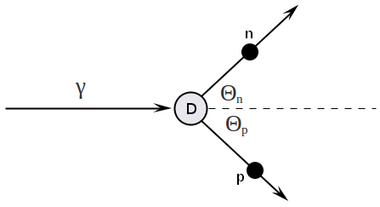
four-vectors algebra

writing four-vectors:
Doing four-vector algebra:
Detector is located at , so
and visa versa
how it looks


low energy approximation
As we can see from Fig.2 for low energy neutrons (0-21 MeV)

energy dependence of incident photons is linear
Find that dependence. We have:
So, the equation of the line is:
Finally for low energy neutrons (0-21 MeV):
example of error analysis
example 1, 1 MeV uncertainty in kinetic energy of neutron</math>
Say, we have, 10 MeV neutron with uncertainty 1 MeV,

the corresponding uncertainly for photons energy is:
example 2,
Say, we have:

   the detector is 1 meter away
   10 MeV neutron
   time of flight uncertainly is 1 ns