[math]\displaystyle{ \textbf{\underline{Navigation}} }[/math]
[math]\displaystyle{ \vartriangleleft }[/math]
[math]\displaystyle{ \triangle }[/math]
[math]\displaystyle{ \vartriangleright }[/math]
Initial CM Frame 4-momentum components
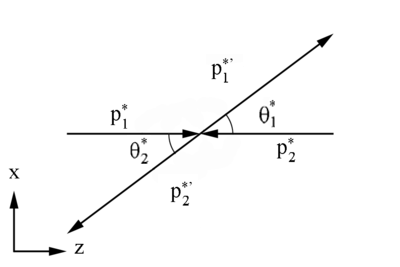 Figure 2: Definition of variables in the Center of Mass Frame
Starting with the definition for the total relativistic energy:
[math]\displaystyle{ E^2\equiv p^2c^2+m^2c^4 }[/math]
[math]\displaystyle{ \Longrightarrow {E^2}-p^2c^2=(mc^2)^2 }[/math]
Since we can assume that the frame of reference is an inertial frame, it moves at a constant velocity, the mass should remain constant.
[math]\displaystyle{ \frac {d\vec p}{dt}=0\Rightarrow \frac{d(m\vec v)}{dt}=\frac{v\ dm}{dt}\Rightarrow \frac{dm}{dt}=0 }[/math]
[math]\displaystyle{ \therefore m=const }[/math]
We can use 4-momenta vectors, i.e. [math]\displaystyle{ {\mathbf P}\equiv \left(\begin{matrix} E\\ p_x \\ p_y \\ p_z \end{matrix} \right)=\left(\begin{matrix} E\\ \vec p \end{matrix} \right) }[/math] ,with c=1, to describe the variables in the CM Frame.
Using the fact that the scalar product of a 4-momenta with itself,
[math]\displaystyle{ {\mathbf P_1}\cdot {\mathbf P^1}=P_{\mu}g_{\mu \nu}P^{\nu}=\left(\begin{matrix} E\\ p_x \\ p_y \\ p_z \end{matrix} \right)\cdot \left( \begin{matrix}1 & 0 & 0 & 0\\0 & -1 & 0 & 0\\0 & 0 & -1 & 0\\0 &0 & 0 &-1\end{matrix} \right)\cdot \left(\begin{matrix} E & p_x & p_y & p_z \end{matrix} \right) }[/math]
[math]\displaystyle{ {\mathbf P_1}\cdot {\mathbf P^1}=E_1E_1-\vec p_1\cdot \vec p_1 =m_{1}^2=\sqrt{s} }[/math]
is invariant.
Using this notation, the sum of two 4-momenta forms a 4-vector as well
[math]\displaystyle{ {\mathbf P_1}+ {\mathbf P_2}= \left( \begin{matrix}E_1+E_2\\\vec p_1 +\vec p_2 \end{matrix} \right)= {\mathbf P} }[/math]
The length of this four-vector is an invariant as well
[math]\displaystyle{ {\mathbf P^2}=({\mathbf P_1}+{\mathbf P_2})^2=(E_1+E_2)^2-(\vec p_1 +\vec p_2 )^2=(m_1+m_2)^2=s }[/math]
