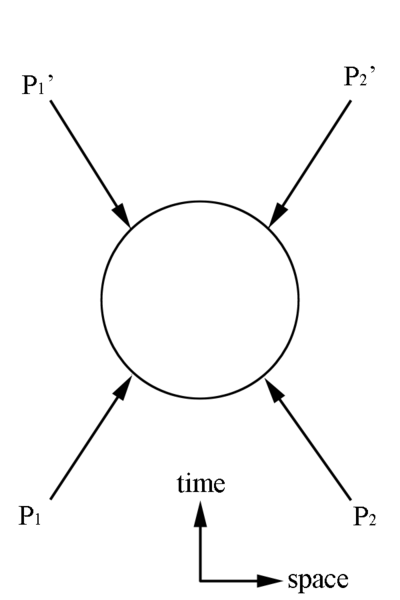
Lorentz Invariant Quantities
Total 4-Momentums
As was shown earlier the scalar product of a 4-Momentum vector with itself ,
[math]\displaystyle{ {\mathbf P_1}\cdot {\mathbf P^1}=E_1E_1-\vec p_1\cdot \vec p_1 =m_{1}^2=s }[/math] ,
and the length of a 4-Momentum vector composed of 4-Momentum vectors,
[math]\displaystyle{ {\mathbf P^2}=({\mathbf P_1}+{\mathbf P_2})^2=(E_1+E_2)^2-(\vec p_1 +\vec p_2 )^2=(m_1+m_2)^2=s }[/math],
are invariant quantities.
It was further shown that
[math]\displaystyle{ {\mathbf P^*}^2={\mathbf P}^2 }[/math]
where [math]\displaystyle{ {\mathbf P^*}=({\mathbf P_1^*}+{\mathbf P_2^*})^2 }[/math] represents the 4-Momentum Vector in the CM frame
and [math]\displaystyle{ {\mathbf P}=({\mathbf P_1}+{\mathbf P_2})^2 }[/math] represents the 4-Momentum Vector in the initial Lab frame
which can be expanded to
[math]\displaystyle{ {\mathbf P^*}^2={\mathbf P}^2={\mathbf P^'}^2 }[/math]
where [math]\displaystyle{ {\mathbf P^'}=({\mathbf P_1^'}+{\mathbf P_2^'})^2 }[/math] represents the 4-Momentum Vector in the final Lab frame
New 4-Momentum Quantities
Working in just the Lab frame, we can form new 4-Momentum Vectors comprised of 4-Momenta in this frame, with
[math]\displaystyle{ {\mathbf P_1}- {\mathbf P_1^'}= \left( \begin{matrix}E_1-E_1'\\ p_{1(x)}-p_{1(x)}^' \\ p_{1(y)}-p_{1(y)}^' \\ p_{1(z)}-p_{1(z)}^'\end{matrix} \right)={\mathbf P_a} }[/math]
[math]\displaystyle{ {\mathbf P_1}- {\mathbf P_2^'}= \left( \begin{matrix}E_1-E_2'\\ p_{1(x)}-p_{2(x)}^' \\ p_{1(y)}-p_{2(y)}^' \\ p_{1(z)}-p_{2(z)}^'\end{matrix} \right)={\mathbf P_b} }[/math]
[math]\displaystyle{ {\mathbf P_2}- {\mathbf P_1^'}= \left( \begin{matrix}E_2-E_1'\\ p_{2(x)}-p_{1(x)}^' \\ p_{2(y)}-p_{1(y)}^' \\ p_{2(z)}-p_{1(z)}^'\end{matrix} \right)={\mathbf P_c} }[/math]
[math]\displaystyle{ {\mathbf P_2}- {\mathbf P_2^'}= \left( \begin{matrix}E_2-E_2'\\ p_{2(x)}-p_{2(x)}^' \\ p_{2(y)}-p_{2(y)}^' \\ p_{2(z)}-p_{2(z)}^'\end{matrix} \right)={\mathbf P_d} }[/math]
Using the fact that the length of these 4-Momentum Vectors are invariant,
[math]\displaystyle{ \left({\mathbf P_1}- {\mathbf P_1^'}\right)^2= \left(\left( \begin{matrix}E_1-E_1'\\ p_{1(x)}-p_{1(x)}^' \\ p_{1(y)}-p_{1(y)}^' \\ p_{1(z)}-p_{1(z)}^'\end{matrix} \right)\right)^2=\left({\mathbf P_a}\right)^2 }[/math]
[math]\displaystyle{ {\mathbf P_1}- {\mathbf P_2^'}= \left( \begin{matrix}E_1-E_2'\\ p_{1(x)}-p_{2(x)}^' \\ p_{1(y)}-p_{2(y)}^' \\ p_{1(z)}-p_{2(z)}^'\end{matrix} \right)={\mathbf P_b} }[/math]
[math]\displaystyle{ {\mathbf P_2}- {\mathbf P_1^'}= \left( \begin{matrix}E_2-E_1'\\ p_{2(x)}-p_{1(x)}^' \\ p_{2(y)}-p_{1(y)}^' \\ p_{2(z)}-p_{1(z)}^'\end{matrix} \right)={\mathbf P_c} }[/math]
[math]\displaystyle{ {\mathbf P_2}- {\mathbf P_2^'}= \left( \begin{matrix}E_2-E_2'\\ p_{2(x)}-p_{2(x)}^' \\ p_{2(y)}-p_{2(y)}^' \\ p_{2(z)}-p_{2(z)}^'\end{matrix} \right)={\mathbf P_d} }[/math]
Mandelstam Representation