|
|
| Line 1: |
Line 1: |
| =Scattering Cross Section= | | =Scattering Cross Section= |
|
| |
|
| <center>[[File:Scattering2.png | 400 px]]</center> | | <center>[[File:Scattering3.png | 400 px]]</center> |
|
| |
|
|
| |
|
Revision as of 18:06, 17 April 2018
Scattering Cross Section
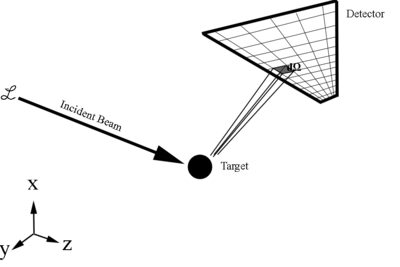
[math]\displaystyle{ \frac{d\sigma}{d\Omega} = \frac{\left(\frac{number\ of\ particles\ scattered/second}{d\Omega}\right)}{\left(\frac{number\ of\ incoming\ particles/second}{cm^2}\right)}=\frac{dN}{\mathcal L\, d\Omega} =differential\ scattering\ cross\ section }[/math]
[math]\displaystyle{ where\ d\Omega=\sin{\theta}\,d\theta\,d\phi }[/math]
[math]\displaystyle{ \Rightarrow \sigma=\int\limits_{\theta=0}^{\pi} \int\limits_{\phi=0}^{2\pi} \left(\frac{d\sigma}{d\Omega}\right)\ \sin{\theta}\,d\theta\,d\phi =\frac{N}{\mathcal L}\equiv total\ scattering\ cross\ section }[/math]
Since this is just a ratio of detected particles to total particles, this gives the cross section as a relative probablity of a scattering, or reaction, to occur.
Luminosity
Luminosity is the quantity that measures the ability of a particle accelerator to produce the required number of interactions and is the proportional to the number of events per second dR/dt and the total cross section σp:
[math]\displaystyle{ dN=\frac{dR}{dt}=\mathcal L \times \sigma_p }[/math]
In order to compute a luminosity for fixed target experiment, it is necessary to take into account the properties of the incoming beam and the stationary target.
[math]\displaystyle{ \mathcal L = \Phi \rho \ell }[/math]
where
[math]\displaystyle{ \Phi \equiv }[/math]flux, or incoming particles per second
[math]\displaystyle{ \rho \equiv }[/math]target density
[math]\displaystyle{ \ell \equiv }[/math]length of target
For the differential cross-section:
[math]\displaystyle{ \frac{d\sigma}{d\Omega} =\frac{dN}{\mathcal L d\Omega}=\frac{dN}{\Phi \rho \ell d\Omega} }[/math]