Lab 3 TF EIM: Difference between revisions
Jump to navigation
Jump to search
| Line 41: | Line 41: | ||
#compare the theoretical and experimentally measured break frequencies. (5 pnts) | #compare the theoretical and experimentally measured break frequencies. (5 pnts) | ||
#Calculate and expression for <math>\frac{V_{out}}{ V_{in}}</math> as a function of <math>\nu</math>, <math>R</math>, and <math>C</math>. The Gain is defined as the ratio of <math>V_{out}</math> to <math>V_{in}</math>.(5 pnts) | #Calculate and expression for <math>\frac{V_{out}}{ V_{in}}</math> as a function of <math>\nu</math>, <math>R</math>, and <math>C</math>. The Gain is defined as the ratio of <math>V_{out}</math> to <math>V_{in}</math>.(5 pnts) | ||
#Sketch the phasor diagram for <math>V_{in}</math>,<math> V_{out}</math>, <math>V_{R}</math>, and <math>V_{C}</math>. Put the current <math>i</math> along the real voltage axis. (30 pnts) | |||
#Compare the theoretical and experimental value for the phase shift <math>\theta</math>. (5 pnts) | #Compare the theoretical and experimental value for the phase shift <math>\theta</math>. (5 pnts) | ||
# what is the phase shift <math>\theta</math> for a DC input and a very-high frequency input?(5 pnts) | # what is the phase shift <math>\theta</math> for a DC input and a very-high frequency input?(5 pnts) | ||
# calculate and expression for the phase shift <math>\theta</math> as a function of <math>\nu</math>, <math>R</math>, <math>C</math> and graph <math>\theta</math> -vs <math>\nu</math>. (20 pnts) | # calculate and expression for the phase shift <math>\theta</math> as a function of <math>\nu</math>, <math>R</math>, <math>C</math> and graph <math>\theta</math> -vs <math>\nu</math>. (20 pnts) | ||
Revision as of 06:11, 21 January 2011
- RC Low-pass filter
1-50 kHz filter (20 pnts)
- Design a low-pass RC filter with a break point between 1-50 kHz. The break point is the frequency at which the filter starts to attenuate the AC signal. For a Low pass filter, AC signals with a frequency above 1-50 kHz will start to be attenuated (not passed).
- Now construct the circuit using a non-polar capacitor.
- use a sinusoidal variable frequency oscillator to provide an input voltage to your filter.
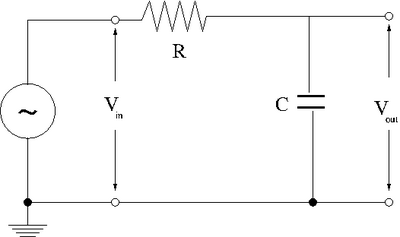
- Measure the input [math]\displaystyle{ (V_{in}) }[/math] and output [math]\displaystyle{ (V_{out}) }[/math] voltages for at least 8 different frequencies[math]\displaystyle{ (\nu) }[/math] which span the frequency range from 1 Hz to 1 MHz.

| [math]\displaystyle{ \nu }[/math] | [math]\displaystyle{ V_{in} }[/math] | [math]\displaystyle{ V_{out} }[/math] | [math]\displaystyle{ \frac{V_{out}}{V_{in}} }[/math] |
| Hz | Volts | Volts | |
- Graph the [math]\displaystyle{ \log \left(\frac{V_{out}}{V_{in}} \right) }[/math] -vs- [math]\displaystyle{ \log (\nu) }[/math]
phase shift (10 pnts)
- measure the phase shift between [math]\displaystyle{ V_{in} }[/math] and [math]\displaystyle{ V_{out} }[/math]
Questions
- compare the theoretical and experimentally measured break frequencies. (5 pnts)
- Calculate and expression for [math]\displaystyle{ \frac{V_{out}}{ V_{in}} }[/math] as a function of [math]\displaystyle{ \nu }[/math], [math]\displaystyle{ R }[/math], and [math]\displaystyle{ C }[/math]. The Gain is defined as the ratio of [math]\displaystyle{ V_{out} }[/math] to [math]\displaystyle{ V_{in} }[/math].(5 pnts)
- Sketch the phasor diagram for [math]\displaystyle{ V_{in} }[/math],[math]\displaystyle{ V_{out} }[/math], [math]\displaystyle{ V_{R} }[/math], and [math]\displaystyle{ V_{C} }[/math]. Put the current [math]\displaystyle{ i }[/math] along the real voltage axis. (30 pnts)
- Compare the theoretical and experimental value for the phase shift [math]\displaystyle{ \theta }[/math]. (5 pnts)
- what is the phase shift [math]\displaystyle{ \theta }[/math] for a DC input and a very-high frequency input?(5 pnts)
- calculate and expression for the phase shift [math]\displaystyle{ \theta }[/math] as a function of [math]\displaystyle{ \nu }[/math], [math]\displaystyle{ R }[/math], [math]\displaystyle{ C }[/math] and graph [math]\displaystyle{ \theta }[/math] -vs [math]\displaystyle{ \nu }[/math]. (20 pnts)